
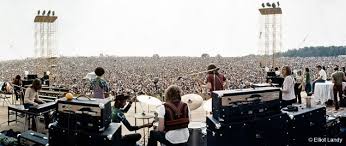
On the fortieth anniversary of the most famous music concert ever, the little town of Woodstock is back in the headlines again.
I live in Woodstock. I moved here when I was nine. I was twelve in 1969 - no way were my parents going to let me go to the concert fifty miles away. But I saw this town when it was clear why the festival organizers wanted to keep the name anyway.
Woodstock was a young town then. It had been an arts colony long before the hippies claimed it, but in 1969 the streets were crowded with long haired, friendly stoners. Music drifted into the street from the Joyous Lake on one end of town and the Cafe Espresso on the other. There was always the smell of leather from the weirdly named leather shop in the center of town. The biggest names in rock could be found jamming a the Espresso or grabbing a pizza at the Millstream Motel.
My first job, just a couple of years later, was to sit in the little rough-lumber shack that served as the Chamber of Commerce information booth at the main intersection into town in front of the Woodstock Playhouse and point down the road to the highway.
"It wasn't here," I told carload after carload of people who wanted to see Max Yasgur's farm. "It wasn't here."
But people came anyway. There was a good vibe in Woodstock and the artists will tell you there always has been. They say it's the mountains.
I left when I went to college and didn't come back to live until thirty years later.
Woodstock 2009 is a changed place, just as the world has changed since then. The music business blossomed here, then withered. The hippies grew up and either burned out or assimilated. The leather shop is gone, replaced by a chic clothing store. The Espresso is a photo gallery. The Lake is a tee shirt and head shop. The musicians who stayed kept pretty much to themselves.
Woodstock has become an old town. Its young people huddle together on the stone steps in front of the empty storefront that was once Just Alan's; the first hip, urban gift shop in town. They show up at the convenient store, their red-rimmed eyes and wobbly gaits making the six packs in their hands seem like overkill. By ten at night, the streets are usually empty.
The older residents, some of whom have been here since before the concert, remember how it used to be and wonder what happened. They miss the music. They miss the life. The laid back attitude is still here, but it's not what it was. It's a quiet country town with a few eccentrics and a weekend tourist trade.
Live music venues are trying to make a comeback in town this year. The winter will determine how many of them survive.
But there's a problem here that I don't think is unique to my town and I saw a demonstration of it tonight.
Woodstock, being Woodstock, always holds it fourth of July fireworks in August. I don't know why. But it's a great show and we go every year. This year I got some insight into at least one difference between the Woodstock I grew up in and the one I live in now.
As the sky lit up with a million lights and the booms echoed off the mountains, kids near us were yelling.
"I love PCP!" "I smoke meth!" "Meth is better than heroin!"
When the crowds flooded the sidewalk back to town, a few of the kids, clearly high, were harassing people as they passed. I won't repeat some of the things they said, but one thing that struck me was this one: "I'm just feeling really violent right now, you know? I want to hurt somebody."
And there's the difference.
I believed, back in the Woodstock of 1969, that the proliferation of drugs was an attempt to realize the connection between us all, an attempt to transcend reality to see something bigger, something even more real. I wasn't doing drugs. I was looking in from the outside. And the people who were doing drugs didn't scare me.
There were angry, troubled people, too, of course. But they were the exception among the hippies I saw every day in town. Most of them were sweet, gentle people who would look you in the eyes and try to have long, earnest conversations about things they thought were really important. They were silly sometimes, but they were kind.
Today's young drug users seem to be angry. They take drugs not to find answers, but to escape. And when they're high, they're even angrier.
I'm not blaming the kids. I'm realizing how the world has changed. We've all become angrier. That weekend of peace and love forty years ago was such a short, sweet interlude. And after that was Kent State, Watergate, so many years of disappointments, disillusionment and disgust culminating in Dick Cheney.
It takes real resilience to hold on to dreams when reality can be so ugly.


